
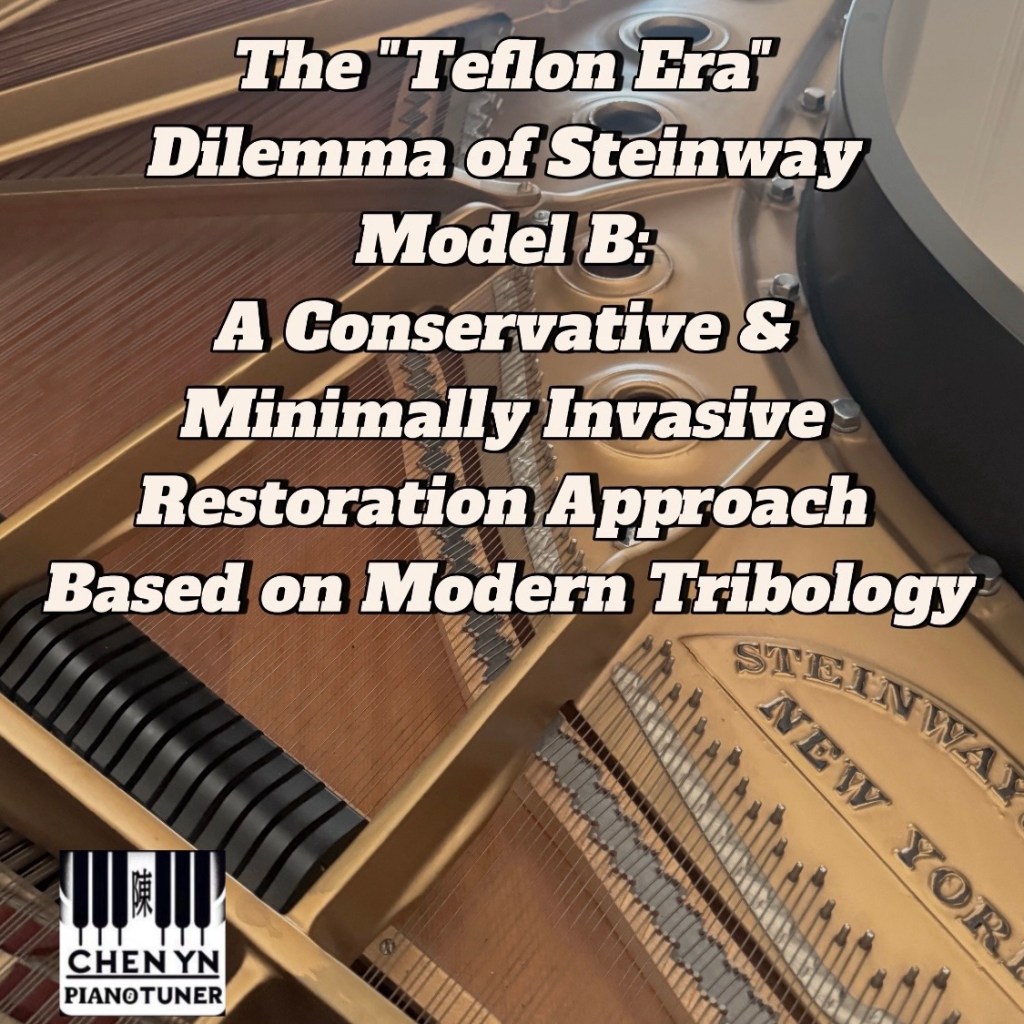
Core Summary:This article introduces a Conservative & Minimally Invasive Restoration approach—a groundbreaking “third alternative” for addressing the notorious “Teflon Era” bushing defects in 1970s Steinway pianos. Bypassing costly and irreversible global action replacements, this method leverages modern tribology and boundary lubrication theories by implementing NSF-certified H1–H3 high-tech synthetic polymers. It dynamically mitigates seasonal dimensional stress between shifting wood and rigid plastic inserts without sacrificing the original soul of the historic instrument, permanently eliminating clicking noises and sluggishness at a highly competitive cost.
Prelude: A Legend of a Harvard Alumna and a Broadway Overture
Sitting in my client’s home, I listened to the owner of this Steinway speak with great animation, recounting the twists and turns of how she used a severance package to first purchase a Yamaha, only to later trade it in for this Steinway. As a fellow parent, I felt a deep emotional resonance hearing about her journey raising her child to play the piano, culminating in their admission to Harvard University. However, what truly left me tongue-tied was learning that she recently resigned from her stable career to pivot into becoming a musical theater director on Broadway! Witnessing such a legendary, multi-talented Harvard mother in my routine tuning career is rare indeed, and I felt compelled to document it.
A Historic Scar: Encountering a “Teflon Era” Model B
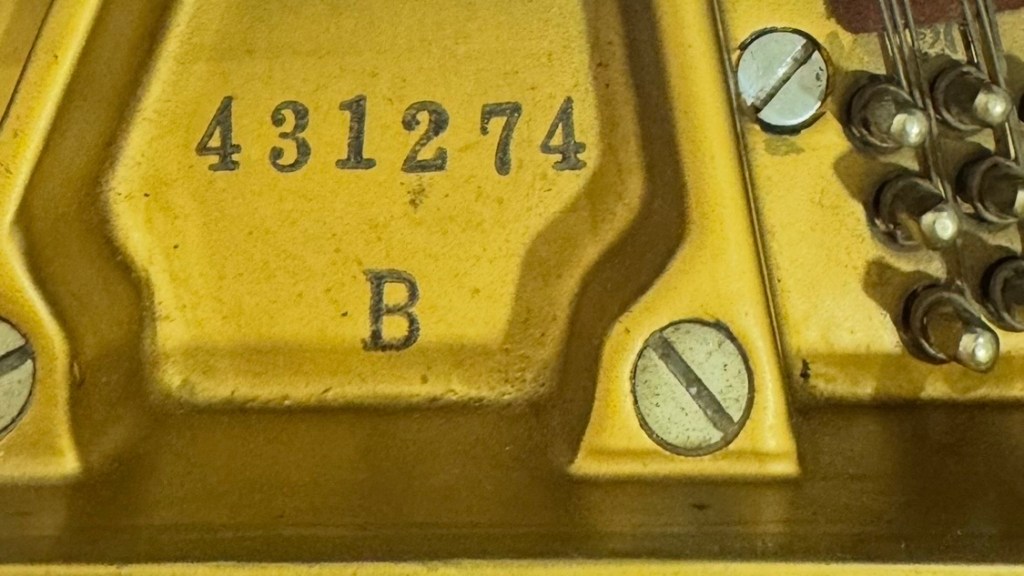
Behind a legendary owner often lies a vintage piano rich with history. The serial number stamped on the plate of this Steinway Model B is 431274, which traces its production precisely back to 1973.
The moment I test-played the instrument, my muscle memory as a professional technician was instantly triggered—the sluggish touch response and subtle clicking noises clearly pointed to the notorious “Teflon Bushings” crisis in Steinway’s history.
Steinway & Sons introduced this plastic bushing technology in 1962 to replace traditional woolen bushing cloth. Between 1962 and 1982, approximately 35,000 pianos worldwide were outfitted with these unlaminated plastic inserts, patented under the name “Permafree”® (U.S. Patent No. 3,240,095). Molded from inert DuPont Teflon, these tiny cylindrical sleeves were engineered to serve the role of traditional “cloth bushings,” with the technical expectation of rendering the action immune to humidity fluctuations.
However, subsequent technical evaluations proved that this innovation fell short of performance expectations. While Teflon itself is an incredibly stable, inert material, the design overlooked the fundamental physics of the wooden action parts (made of maple), which constantly “breathe” in response to seasonal humidity shifts in New York and around the globe. When the wood swells, it squeezes the Teflon, causing the center pins to bind and the keys to become sluggish; conversely, when the wood shrinks in dry seasons, a gap forms between the Teflon sleeve and the wood bore. This dimensional conflict is the root cause of touch failures and the infamous “clicking” noises.

Breaking the Deadlock: From Orthodox Steinway Training to Innovative Remedies
During my systematic factory training at Steinway, mastering the proper, non-destructive handling of Teflon bushings was a core qualification subject. Although the total number of Teflon-equipped vintage pianos I encounter in New York nowadays is modest, I have always been able to remediate them with ease and satisfaction. The key prerequisite lies in transcending rigid traditional dogmas and employing innovative strategic thinking.
Years of clinical experience have demonstrated that the traditional “dry-only” approach (completely avoiding lubricants) yields sub-optimal touch refinement when dealing with half-century-old, deformed Teflon and center pins, and symptoms often recur in the short term.
To break this deadlock, I implemented a groundbreaking attempt on this 1973 Model B: introducing a modern, high-tech synthetic polymer lubricant certified for NSF/PAP H1–H3 standards.
1. Fine Intervention of Modern Synthetic Polymers
Traditional chemical lubricants (such as WD-40 or inferior micro-powders) can accelerate wood degradation or induce microscopic swelling in Teflon. In contrast, H1–H3 grade modern synthetic lubricants possess exceptional material compatibility, oxidation resistance, and zero chemical corrosiveness. Utilizing a high-precision micro-injector, I allowed a minute volume of the fluid to capillary-penetrate into the microscopic interface between the Teflon sleeve and the nickel-silver center pin. This advanced material effectively fills microscopic surface irregularities, instantly neutralizing the “stress-induced drag” caused by aging plastic and restoring a silky, controlled damping resistance to the touch.
2. Composite Process of Micro-Expansion and Reaming
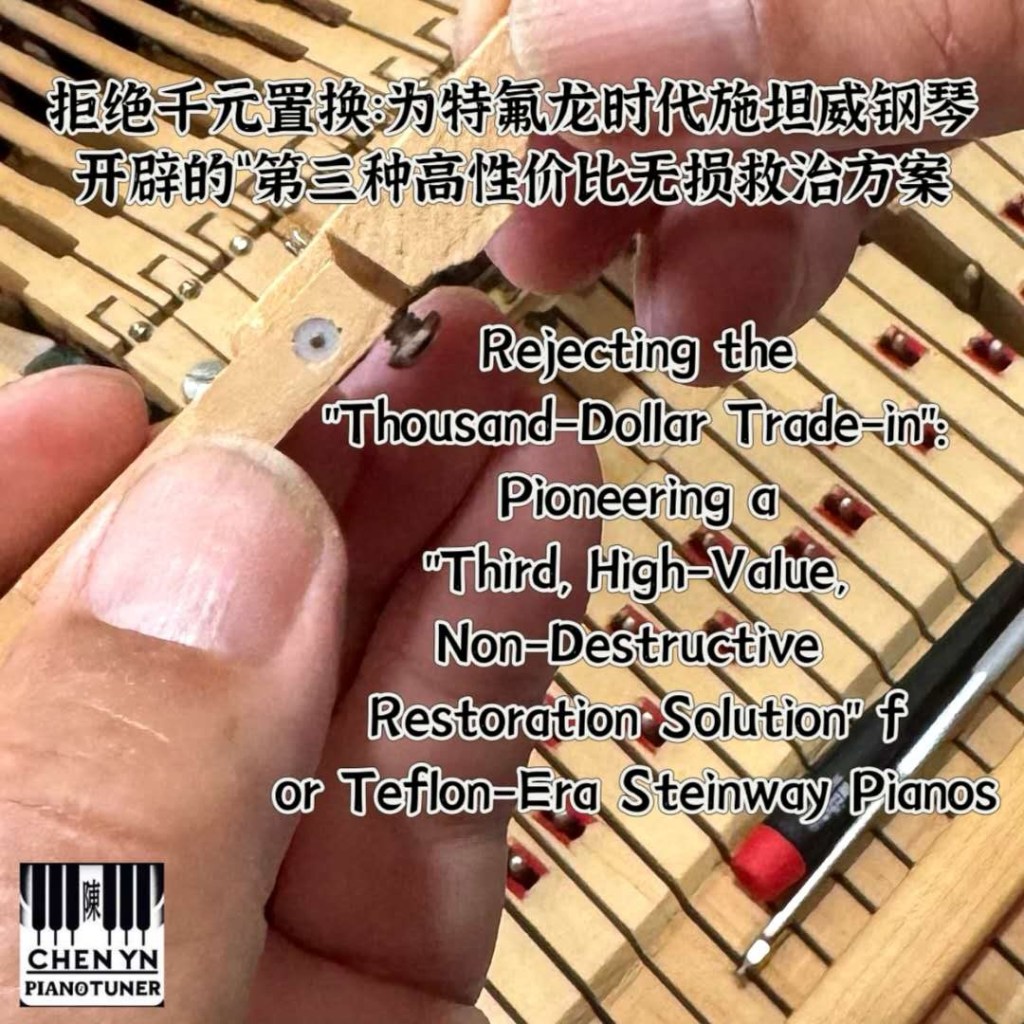
For components where shrinkage caused looseness and clicking, I applied a precision micro-needle expansion technique to re-secure the Teflon sleeve tightly against the wooden bore. For the few hinges that were overly tight due to wood compression, I adhered strictly to original Steinway factory specifications, utilizing specialized Teflon reamers to execute micron-level calibrations. This ensured that the swing frequency (Swing Test) of every flange perfectly matched the specific transmission velocity required by a Steinway Model B.
Conclusion: Returning a Silky Touch to the Broadway Stage
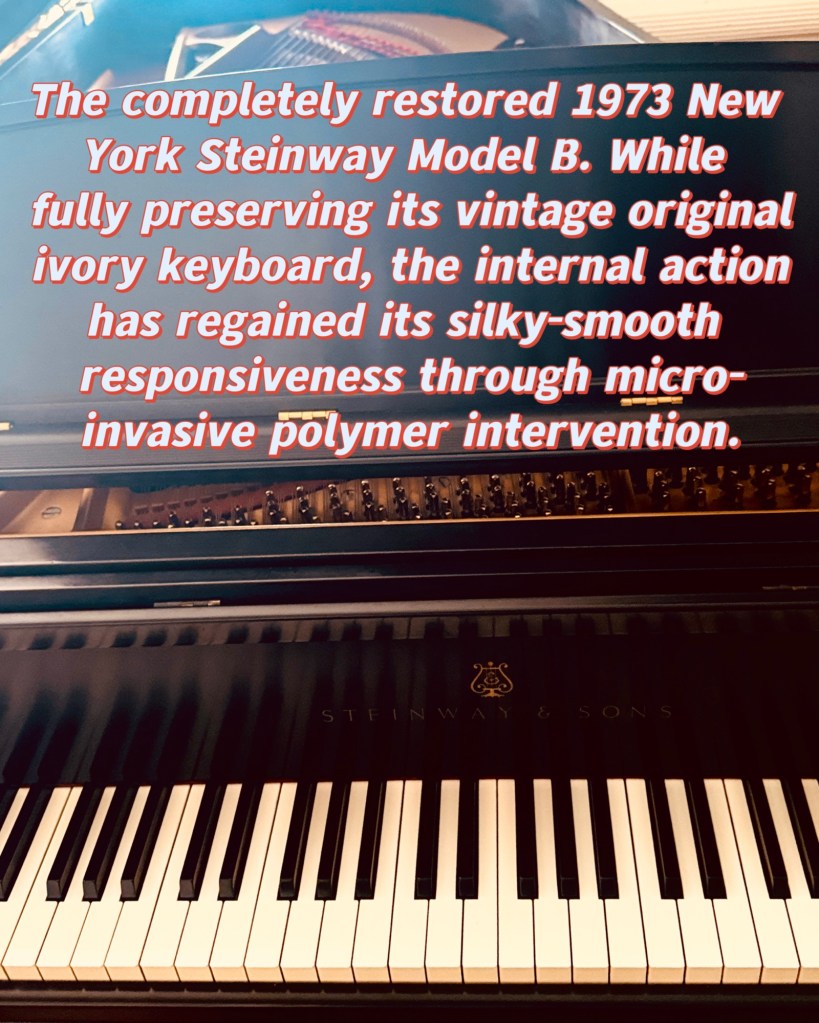
Following this composite treatment—which harmonizes “traditional factory protocols” with “modern materials chemistry”—this 50-year-old Steinway Model B has been completely revitalized. The previously sluggish, noise-marred keyboard action instantly recovered the characteristic responsiveness and buttery density of a fine Steinway, flawlessly translating every nuanced expression of the performer’s fingertips.
Watching this brilliant Harvard alumna, now poised for the Broadway stage, smile once more at the piano bench as her music flowed effortlessly across the keys, I reminded myself: this is precisely the most gratifying and fulfilling moment of being a New York piano technician.


Leave a Reply