
Three Deep Physical Logics behind the Technical Details of Lateral Voicing
Author: ChenYN Piano Tuner
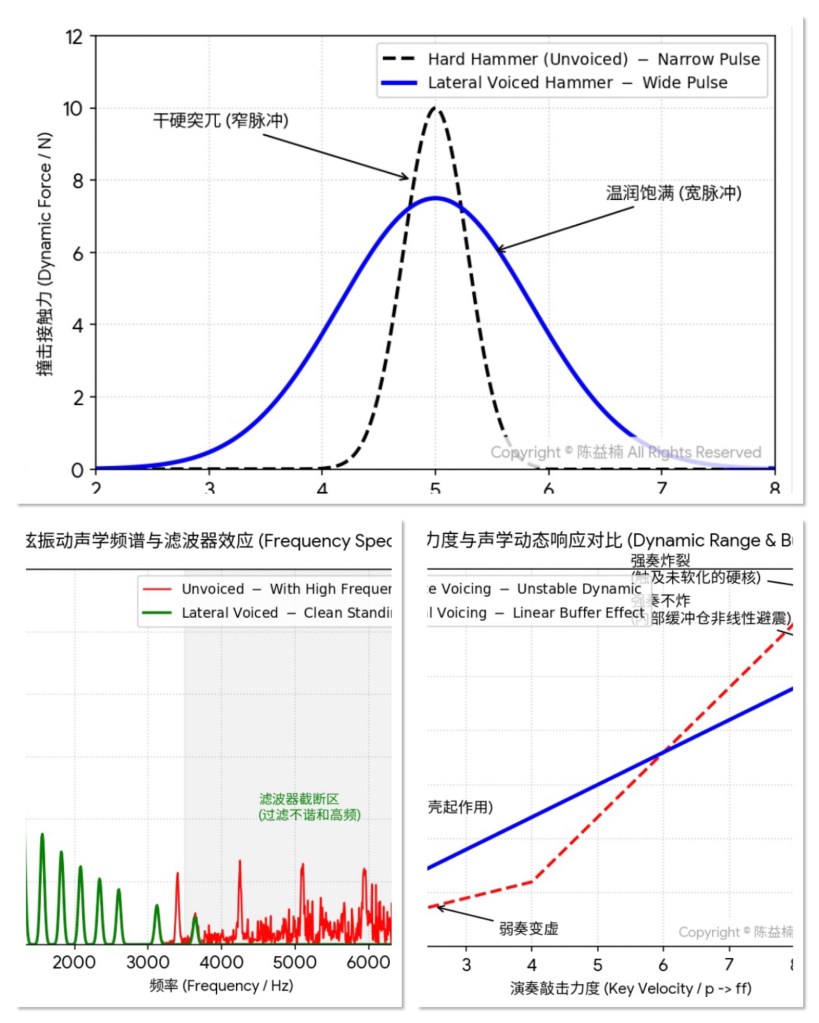
The core breakthrough of the micro-invasive art of Lateral Voicing lies in the philosophy of “preserving the surface while releasing internal tension.” The execution of this technique is governed by three profound principles of physical acoustics:
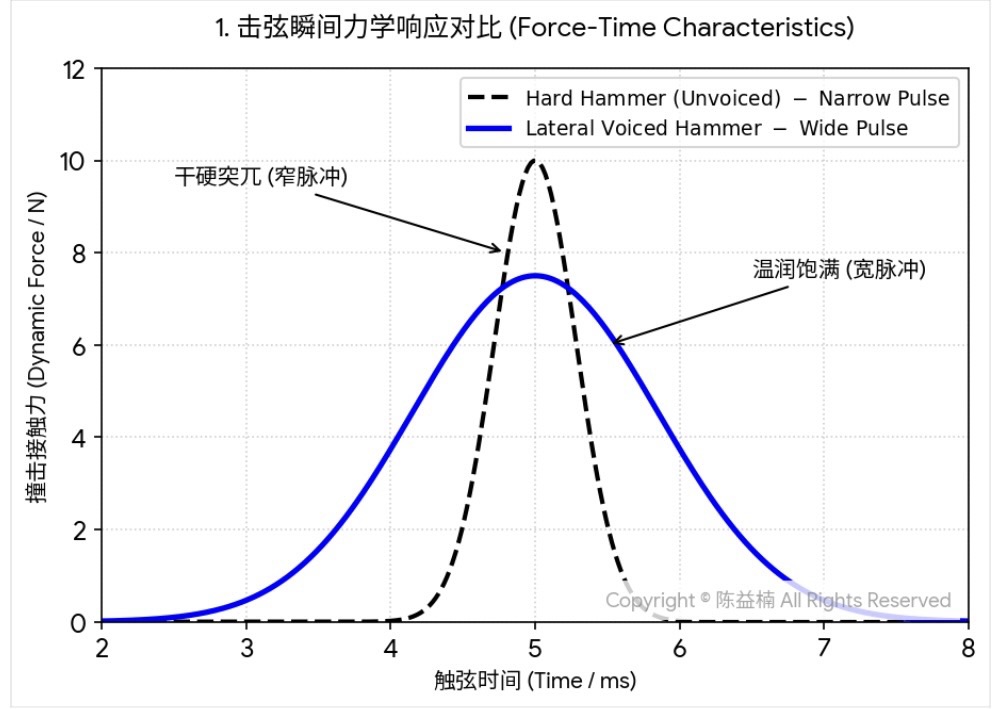
1.Altering the Damping Control Characteristics of the “Non-Linear Spring “改变“非线性弹簧”的阻尼特性
When a piano hammer strikes a string, the physical interaction is essentially an ultra-rapid process of compression and rebound. If the internal core of the hammer is excessively rigid, it behaves like a piece of “dead wood” colliding with the string. This results in an extremely brief contact duration and a harsh, abrupt release of energy.
By introducing needles laterally into the core tension zone, you effectively engineer microscopic air gaps and elastic tolerances inside the hammer felt. This successfully optimizes the hammer’s Dynamic Stiffness. Consequently, upon string impact, the mechanical collision ceases to be a rigid slam; instead, it generates a desirable “wide pulse” acoustic wave.
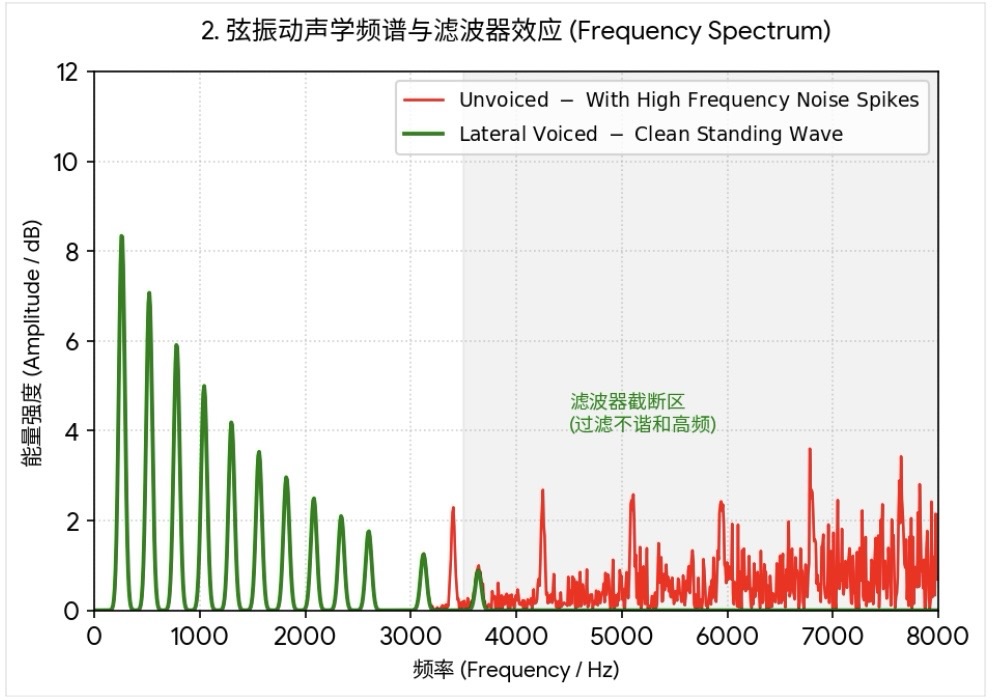
2. Optimizing the Purity of the Standing Wave 优化“驻波”的纯净度
When a dried, overly rigid hammer strikes a string, it inevitably excites a vast array of chaotic, high-frequency inharmonic partials (Noise spikes). These high-frequency energies rapidly drain the vibration energy of the string, causing the resultant tone to dissipate prematurely and sound disorganized.
The strategic brilliance of Lateral Voicing lies in the fact that it completely leaves the surface tension of the strike point (Crown) uncompromised, while deliberately softening the internal support architecture. This transforms the hammer into an ideal acoustic “filter.” At the split second of impact, it filters out the energy-draining, piercing noise spikes, allowing the vibrational energy to cleanly concentrate on the fundamental tone and concordant partials.
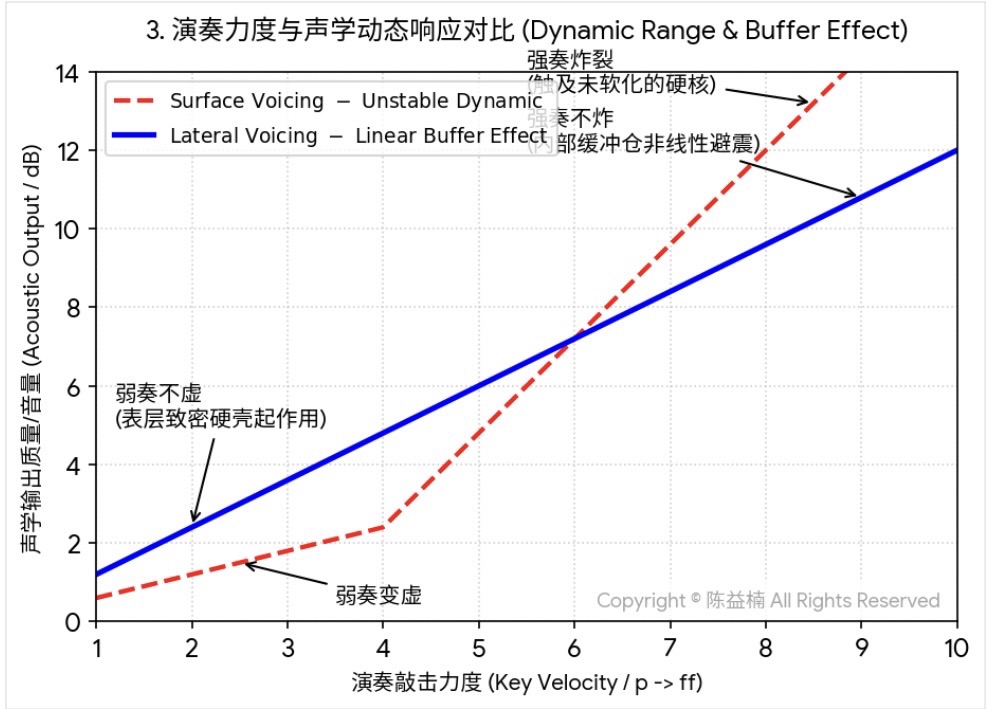
3. Creating the “Energy Buffer Chamber” Effect营造“能量缓冲室”效果
Traditional surface needling techniques inadvertently make the outer layer of the hammer “hollow” or “mushy,” which leads to an uninspired, weak projection. In contrast, Lateral Voicing penetrates from the sides, meticulously preserving the density and integrity of the hammer’s exterior (acting as a firm outer shell) while establishing a resilient, flexible “buffer chamber” within the core.
This manipulation seamlessly accomplishes the holy grail of tone regulation: “powerful fortissimo without harsh shattering, and delicate pianissimo without loss of body.”/> During the decay of the sound, this architecture acts as an acoustic shock absorber for the piano. The sound no longer terminates abruptly; rather, it blooms and diffuses outward in organic, undulating layers, much like concentric ripples on a water surface.
Author: Yin-Nan Chen

 New York Piano Tuner : I used ear tuning (also known as auditory tuning) and state-of-the-art software-based electronic tuning equipment for sound tuning. (The frequency for home concert tuning is 440 Hz.) 我采用耳调音法(也称听调音法)和最先进的基于软件的电子调音设备进行调音。(家用音乐会调音的频率为 440 Hz) Chen YN 调音主页
Leave a comment