
博兰斯勒 210与施坦威 211调律弹奏同作品测试
Bolansler 210 and Steinway 211 tuning playing the same work test
2025年纽约曼哈顿钢琴调律杂记:博兰斯勒钢琴Blüthner Model 4 (210): 210cm(6′ 10″)调律后测试弹奏《我爱你中国》留下曼妙的印记……感觉博兰斯勒的音色既有温暖抒情的圆润声音,也有比其他品牌的钢琴更低沉深邃的延音及泛音效果。
博兰斯勒钢琴的弹奏手感细腻精致、键盘动态好、弹奏能量很大,此次调律还验证了雷诺击弦机及Aliquot 系统特别是高音区独立的第四弦设计,钢琴泛音的频感达到巅峰之作、揭秘了钢琴界的“共鸣奇迹”。
博兰斯勒的音色听起来甜美且有质感,无论是细微还是宏观都彻底颠覆了我的认知和印记。多年来从国内到国外各种品牌钢琴的调律及见闻,博兰斯勒爱好者远低于贝森朵夫和贝希斯坦爱好者。至于盯着施坦威的专业学生及家长更不认识这是什么牌子,据说有人还曾验证过博兰斯勒位居钢琴大牌贬值排行榜第一名。
据说追求音色的德彪西认为“如羽毛般轻盈的触键”《版画》(Estampes)里的第一首《塔》(Pagodes)曲末,利用弱音踏板弹出“尽可能的小声”降低音群的节奏感……形成整片的色彩。在博兰斯勒钢琴上泛音是可以明显做到,以至于可以听到琴声融进空气中的效果。
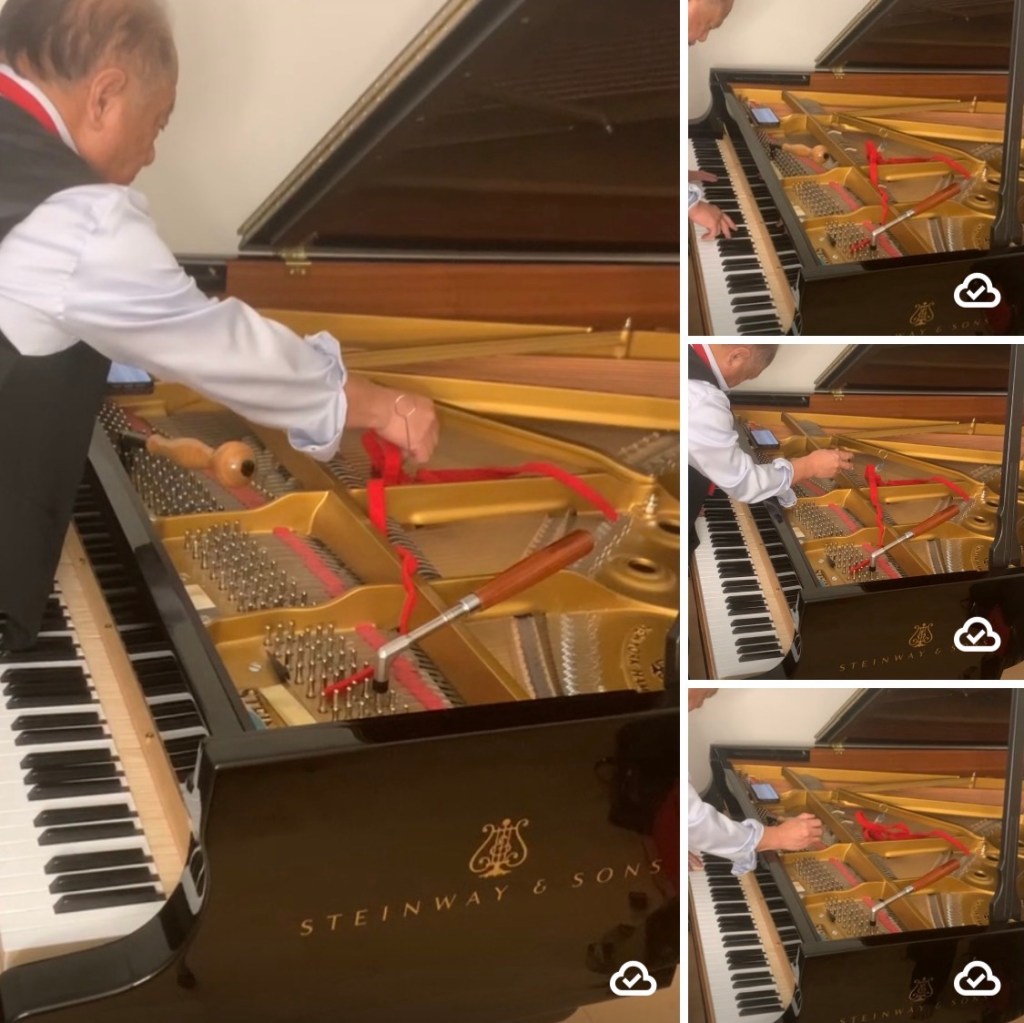
施坦威钢琴 B(211)211cm (6’11”)弹奏的感觉会让你瞬间感觉不一样的最主要原因是速度,这个速度重点在材料中也就是更低的能量损耗。至于斯坦威的音色有太多钢琴家解释和优质的认同,我个人认为这个音色其实是由内向外的;多年的从业经验特别是测试调整中发现,如果在速度上达不到要求, 即使当榔头特别优秀的时候, 也能够非常清楚的听到钢琴本身音色的弱点。我清楚的记得客户希望我给施坦威整音或者说添加色彩不一样的音色时,所有的色彩弹性全部依赖于榔头不同区域的软硬的控制,响与轻也是混在色彩里一起完成的。
我深受纽约施坦威钢琴工厂罗恩·科纳斯(Ron Coners)首席音乐会技师的影响,他曾长期负责纽约卡内基音乐厅和林肯中心的施坦威钢琴维护。他以处理钢琴的“触感(Action)”和极度细腻的“整音(Voicing)”而闻名,许多钢琴家指名要求他为其录音或音乐会准备钢琴。他的理念之一就是首先概念要清晰,榔头的弹性、色彩、硬软、及材质是完全不同的,不可纠缠在一起…区分是最重要的一步。
《我爱你中国》 这首艺术歌曲的钢琴伴奏使用了大量的琶音,每一个乐句都以一个抛物线的方式结束,音程跨度很大。厚重的低音及四五度和声效果加上左右手主旋律的交叉织体,犹如歌词引子部分描写的那样百灵鸟栩栩如生的画面。从钢琴技术方面来看,引子部分是由八度加上跑动构成,大范围的跑动弹奏增强了对比性堪称钢琴伴奏精品之一。《我爱你中国》的和声渲染效果在博兰斯勒钢琴调音完毕的测试中效果非常好,也是2023年中国央视春晚用琴。博兰斯勒Blüthner钢琴是全球现存唯一一个由原始德国家族传承经营的大型顶级钢琴制造商,很荣幸地被许多欧洲国家指定为皇室收藏乐器,如德国陛下、维多利亚皇后、俄国沙皇、丹麦国王、奥地利国王等都曾收藏过博兰斯勒钢琴。
Blüthner博兰斯勒/Steinway施坦威的调律弹奏同作品测试对比如下:
1. 博兰斯勒 (Blüthner)具有黄金音色的“透明感”,博兰斯勒被称为“钢琴中的诗人”,其音色核心在于温暖、含蓄且具有极高的透明度。高音区的“共鸣共振”以及博兰斯勒最标志性的技术是第四根弦(Aliquot Scaling),这使得其高音并非靠硬力敲击出的明亮,而是一种带有丝绒感的、丰盈的泛音色彩 。其音色的层次感低音深沉但不浑浊,中音部具有极强的叙事性。相比于施坦威的爆发力,博兰斯勒更强调音色的歌唱性(Cantabile),适合表现德奥派系古典乐的细腻层次。
2. 施坦威 (Steinway)具有交响化的“爆发力”,施坦威追求的是音色调色盘的广度与极强的声音投影能力。全频段的张力让施坦威的音色得以“交响化”著称。施坦威的材质得益于其整体铸铁板设计和独特的音板横梁压强技术,它能从极弱(pp)到极强(ff)提供巨大的动态范围。施坦威音色的“攻击性”与持久性具有极强的穿透力,带有金属质感的明亮感。其泛音列非常活跃,使得声音在大型音乐厅中具有极佳的传播距离(Projection)。
3. 从调音师角度看整音与手感:整音(Voicing)逻辑: 施坦威的榔头通常需要通过精细的针刺和润化手段来强化控制硬度,以达到理想的亮度和色彩的变化。而博兰斯勒的榔头通常较软,更依赖琴弦本身的物理共振特性弹奏技巧的升华。手感与反馈: 施坦威的击弦机通常调校得极度灵敏,适合高难度的技巧演奏,而博兰斯勒则带有一种温润的阻尼感,触键反馈更为内敛和柔美。由于钢琴的音色表现极大程度上取决于后天的整音(Voicing)状态和使用环境,每台钢琴的具体表现还需结合其保养状态及调音师的个性化整音。
4.从调音师角度看击弦机传动:施坦威 (Steinway)其核心在于专利的加速击弦机(Accelerated Action)。通过中轴架(Balance Rail)的圆型支点设计,减少了触键初期的静摩擦力。这使得施坦威的手感极度“顺滑”且起速极快,演奏者会感觉到按键仿佛能自动弹回,非常适合快速的跑动音型。博兰斯勒 (Blüthner): 手感通常更显“稳健”与“线性”。其击弦机调校侧重于可控性,触键反馈相对平和。虽然没有施坦威那种极端的启动加速度,但它为演奏者提供了极佳的“深度感”,在弹奏长线条、歌唱性旋律时,手指能更精准地感受到击弦瞬间的受力。
5. 从调音师角度看阻尼反馈的微差:施坦威钢琴追求统一的物理反馈,无论是在高音区还是低音区;施坦威通过精确的配重平衡,使得整体手感的一致性极高。其制音器(Damper)的开启通常调校得较为干脆,配合较深的键深(通常在10mm-10.5mm左右),给演奏者一种掌控宏大动态的自信。博兰斯勒钢琴往往具有一种独特的“丝绒阻尼感”,由于博兰斯勒在设计上强调室内乐的细腻,其踏板和触键的反馈通常被调校得更轻盈。甚至在一些古典型号中,博兰斯勒的键深会设定得略浅(如9.5mm左右),这使得弹奏极弱音(pp)时,手指能够实现更加细腻的微操。
6.从钢琴家演奏角度看力量的交响感及层次感:施坦威钢琴适合“爆发型”演奏,由于击弦机几何设计的优化,施坦威在强奏(ff)时能承受极大的力量输入而不会产生明显的机械滞后感。这种手感被形容为“直接连通琴弦”,非常适合现代大型协奏曲。博兰斯勒钢琴侧重于“多维色彩”,博兰斯勒的手感在表现中弱到中强音阶时具有无与伦比的层次感。虽然在物理爆发力上略逊于施坦威,但它在指尖传递出的微弱震动反馈,能引导钢琴家去挖掘更多柔和的音色变化。
(参考资料) 施坦威(Steinway)的技术专利说明/博兰斯勒(Blüthner)的黄金音色工艺介绍
ChenYN Piano Tuner 陈师傅调音 2026 年1月于纽约曼哈顿 http://chenynpiano.com.
2025 Manhattan, New York Piano Tuning Notes: Blüthner Model 4 (210): 210cm (6′ 10″) Piano. After tuning, a test performance of “I Love You, China” left a beautiful impression… The Blüthner’s tone felt both warm and lyrical, with a deeper, more resonant sustain and overtones compared to other brands.
The Blüthner piano has a delicate and refined touch, excellent keyboard dynamics, and great playing power. This tuning also verified the performance of the Reynolds action and Aliquot… The system, especially the independent fourth string design in the high register, achieves a pinnacle in the frequency response of piano overtones, revealing a “resonance miracle” in the piano world.
The Blüthner’s tone sounds sweet and textured, completely overturning my perceptions and impressions, both in subtle and macroscopic aspects. Having experienced tuning and observing various piano brands both domestically and internationally over the years, I find far fewer Blüthner enthusiasts than Bösendorfer or Bechstein enthusiasts. As for professional students and parents who focus on Steinway, they are even less familiar with the brand; it’s said that someone once verified that Blüthner ranks first on the list of major piano brands that depreciate in value.
It is said that Debussy, who pursued perfect tone, believed that “feather-light touch” at the end of the first piece, “Pagodes,” in his “Estampes,” using the soft pedal to play “as softly as possible” to reduce the rhythmic feel of the notes… creating a unified color. On a Blüthner piano, overtones are clearly achievable, to the point that you can hear the sound blending into the air.
The main reason why playing a Steinway B (211) 211cm (6’11”) piano feels instantly different is its speed, which is primarily due to the lower energy loss in the materials. As for the Steinway’s tone, there are many pianists who have offered explanations and high praise. Personally, I believe this tone is actually emanating from within. Years of experience, especially in testing and adjustments, have shown that if the speed requirement isn’t met, even with exceptionally good hammers, the weaknesses in the piano’s tone can be clearly heard. I vividly remember when clients wanted me to voicing a Steinway or add a different tone, all the tonal flexibility relied entirely on the control of the hammers’ different areas of hardness and softness; loudness and softness were also achieved within the overall tone.
I am deeply impressed by Ron Corners of the New York Steinway Piano Factory… Influenced by his experience as a chief concert technician at Coners, he had long been responsible for the maintenance of Steinway pianos at Carnegie Hall and Lincoln Center in New York. He was renowned for his handling of the piano’s “action” and extremely delicate “voicing,” and many pianists specifically requested him to prepare pianos for their recordings or concerts. One of his philosophies was that the concept must be clear from the start; the elasticity, color, hardness, and material of the hammers are completely different and should not be confused… differentiation is the most important step.
(I Love You, China) The piano accompaniment of this art song utilizes numerous arpeggios, with each phrase ending in a parabolic arc and spanning a wide range of intervals. The rich bass lines and harmonic effects of fourths and fifths, combined with the interwoven texture of the main melody in both hands, vividly evoke the image of a lark described in the lyrics’ introduction. From a technical perspective, the introduction, composed of octaves and runs, enhances the contrast with its expansive playing, making it a masterpiece of piano accompaniment. The harmonic rendering of “I Love You, China” performed exceptionally well in tests on Blüthner pianos after tuning, and it was also the piano used in the 2023 CCTV Spring Festival Gala. Blüthner is the only remaining major top-tier piano manufacturer in the world still operating under a family tradition rooted in Germany. It has been honored to be designated as a royal collection instrument by many European countries, including His Majesty the German Emperor, Empress Victoria, the Russian Tsar, the King of Denmark, and the King of Austria.
The following is a comparison of Blüthner’s tuning and playing with Steinway pieces:
- Blüthner possesses a “transparent” quality to its golden tone. Often called the “poet of the piano,” Blüthner’s tone is characterized by warmth, subtlety, and exceptional transparency. The “resonance” in the high register and Blüthner’s signature technique of liquot scaling on the fourth string result in high notes that are not achieved through forceful striking, but rather through a velvety, rich overtone. Its tone is layered, with a deep but not muddy bass and a highly narrative middle register. Compared to Steinway’s explosive power, Blüthner emphasizes the cantabile quality of its tone, making it suitable for expressing the delicate layers of German and Austrian classical music.
- Steinway possesses a symphonic “explosive power.” Steinway pursues a broad tonal palette and exceptional sonic projection capabilities. Steinway’s full-range tension is renowned for its “symphonic” tone. Thanks to its monocoque cast iron design and unique soundboard beam pressure technology, Steinway provides a vast dynamic range from very soft (pp) to very loud (ff). The “aggressiveness” and persistence of Steinway’s tone possess exceptional penetrating power, with a metallic brightness. Its overtone series is very active, resulting in excellent projection in large concert halls.
- Voicing and Playability from a Tuner’s Perspective: Voicing Logic: Steinway hammers typically require precise needle work and lubrication to enhance hardness control, achieving ideal brightness and color variations. Blüthner hammers, on the other hand, are generally softer, relying more on the physical resonance characteristics of the strings and the refinement of playing techniques. Touch and Feedback: Steinway’s actions are typically tuned to be extremely sensitive, suitable for highly technical playing, while Blüthner’s have a warmer, damped feel, with a more restrained and mellow touch feedback. Since a piano’s tone largely depends on its voicing and usage environment, each piano’s specific performance must be considered in conjunction with its maintenance and the tuner’s personalized voicing.
- From a Tuner’s Perspective on Action Transmission: Steinway’s core lies in its patented Accelerated Action. Through the circular pivot point design of the Balance Rail, static friction is reduced at the initial touch. This makes Steinway’s touch extremely “smooth” and incredibly fast; the player feels as if the keys automatically spring back, making it ideal for fast runs. Blüthner: The touch is generally more “solid” and “linear.” Its action tuning emphasizes controllability, with relatively mild key feedback. While lacking the extreme acceleration of a Steinway piano, it provides the player with excellent “depth,” allowing for more precise finger pressure at the moment of impact when playing long, lyrical melodies.
- From a tuner’s perspective, subtle differences in damping feedback: Steinway pianos strive for consistent physical feedback, both in the high and low registers. Through precise weight balance, Steinway achieves a high degree of consistency in overall touch. Its dampers are typically tuned for a crisp opening, combined with relatively deep keys (usually around 10mm-10.5mm), giving the player a confident grasp of grand dynamics. Blüthner pianos often possess a unique “velvety damping feel.” Because Blüthner’s design emphasizes the subtlety of chamber music, its pedal and key feedback is usually tuned for a lighter touch. Even in some classical models, Blüthner pianos have a slightly shallower key depth (around 9.5mm), allowing for more delicate finger manipulation when playing very soft (pp).
- From a pianist’s perspective, the symphony and layering of power: Steinway pianos are suitable for “explosive” playing. Due to the optimized geometry of the action, Steinway can withstand extremely high power input without noticeable mechanical lag during forte (ff). This feel is described as “directly connected to the strings,” making it very suitable for modern large-scale concertos. Blüthner pianos emphasize “multi-dimensional color.” Blüthner’s touch offers unparalleled layering in the expression of soft to mezzo-forte scales. While slightly less physically explosive than Steinway, its subtle vibrational feedback at the fingertips guides the pianist to explore more nuanced tonal variations.
(Reference Materials) Steinway’s Technical Patent Description / Blüthner’s Gold Tone Craftsmanship Introduction
ChenYN Piano Tuner, January 2026, Manhattan, New York http://chenynpiano.com

 New York Piano Tuner : I used ear tuning (also known as auditory tuning) and state-of-the-art software-based electronic tuning equipment for sound tuning. (The frequency for home concert tuning is 442 Hz.) 我采用耳调音法(也称听觉调音法)和最先进的基于软件的电子调音设备进行调音。(家用音乐会调音的频率为 442 Hz) Chen YN 调音主页
Leave a comment