
摘要:
本文探讨 W. Hoffmann T系列 钢琴的音色重塑,通过对比欧美音色差异,提出 “横向侧面针刺(Lateral-Invasive Voicing)” 创新技法。该法通过侧向释放榔头内压,完美解决“柔和”与“亮度”的传统矛盾。实证表明,该技法在保护击弦面(Crown)的同时,显著延长音色衰减时间(Sustain Decay),赋予钢琴卓越的“歌唱性”。This study analyzes W. Hoffmann T-Series tonal reconstruction, introducing “Lateral-Invasive Voicing” for German hammers. By releasing side tension, it harmonizes softness and brilliance without damaging the crown. Results show significantly extended Sustain Decay, transforming mechanical sound into a lyrical “Singing Tone.”
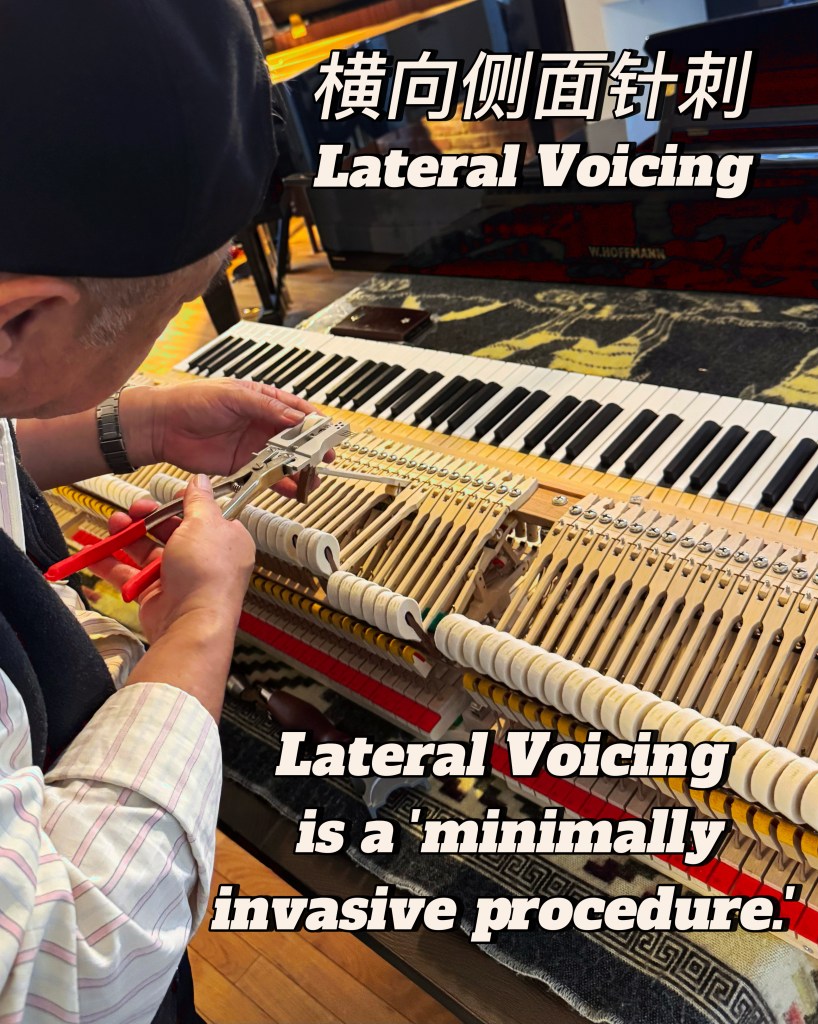
我从事钢琴调音将近四十年,多年来困扰我的诱惑依然是如何鉴别钢琴的音色。很多时候钢琴的音色并没有变“差”,而唤醒钢琴纯净音色的肯定是来自于工匠的底气……等待一个真正听懂它灵魂的人。不久前 W.Hoffmann 霍夫曼钢琴主人的评价“Leagues above any other tuner I have ever had” 再次让我领略到“软而不闷、亮而不刺”…“珍珠落玉盘”之音色。
近年来在美国多次接触欧洲钢琴对欧洲音色 (European Sound) 诸如 W. Hoffmann等品牌基音的清晰度,泛音列整齐且透明度、强调“纯净度(Purity)”与“方向感(Clarity)”、特别是Cold-Pressed (冷压)技术等,这是区别于普通琴“热压”工艺的灵魂。W. Hoffmann 这种德系欧洲音色手工琴的原始张力暨血统……唤醒了我对德系纯净音色的工匠探究底气。
美国音色(American Sound)如施坦威(steinway&Sons)的泛音极其密集且宽广,其审美的核心是爆发力和交响感;无论是音色还是线条都具有浓郁和华丽的宽广及油画般的厚度(Thickness)”与“融合感(Blend)”,在英文环境中我非常欣赏的词组为 “Enhanced Tonal Bloom”(音色的绽放感)或 “Optimized Decay Profile”也被许多国人称之如同顶级高音般的‘歌唱性延音’。
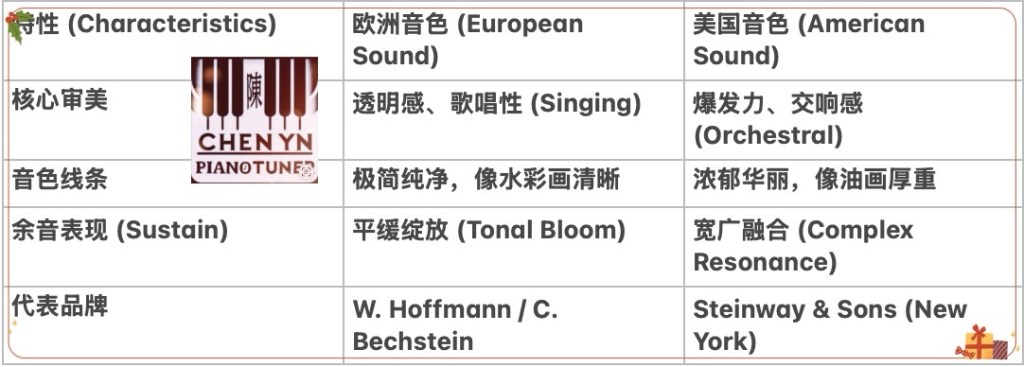
我是调音、整音、维修累积千余架的工匠,体会最深的还是区别欧洲音色与美国音色应从榔头的核心数据细节入手。从“噪音”到“和声”其核心点是透明感(Transparency) vs. 爆发力(Power),认定榔头是钢琴的“声带”。W. Hoffmann T系列 继承的 C. Bechstein 德国原厂冷压技术,Wurzen 顶级毛毡 的高密度纤维结构“冷压”工艺保留了羊毛的天然油脂和弹性。不同于普通琴的热压工艺,它不是靠“硬碰硬”,而是靠“柔而韧”,对比施坦威(Steinway)的那种如同管弦乐团般的“厚重感与轰鸣声”而言,调音师这位音色的“翻译官”面对于W. Hoffmann 这种典型的欧系“透明感(Transparency)”骤然感觉到了“豁然开朗、别有洞天”。
“Technique & Theory by Master Chen”陈师傅技术与理论支持关于“欧洲音色 vs. 美国音色”构思设计有三个层面:方案一:音色衰减对比图 (Sustain Decay Envelope)其中软件视觉呈现两条振幅曲线对比,普通整音(点状线):击弦瞬间峰值极高(燥刺),但随后呈陡峭下跌,余音短促。横向整音后的 W. Hoffmann(实线):击弦峰值圆润平滑,余音衰减过程极其缓慢且平稳。具有优化的衰减剖面”Optimized Decay Profile”
方案二:榔头受力结构剖面图 (Stress Distribution Analysis)现场查看一个榔头侧面的剖析,用不同颜色标注受力区。红色区(击弦点 Crown):标注“保持紧致(Preserved Tension)”,确保亮度。蓝色区(侧向针刺核心区 Core):标注“内压释放(Tension Released)”,创造内部缓冲仓。这种技法能实现“柔而不闷,亮而不刺”之音色。
方案三:欧系与美系音色频谱对比 (Spectral Comparison)其中软件的视觉呈现:两组泛音列频率分布柱状图。美国音色(如施坦威):泛音极其密集且宽广,强调“厚度(Thickness)”与“融合感(Blend)”。欧洲音色(如 W. Hoffmann):基音清晰,泛音列整齐且透明,强调“纯净度(Purity)”与“方向感(Clarity)”。
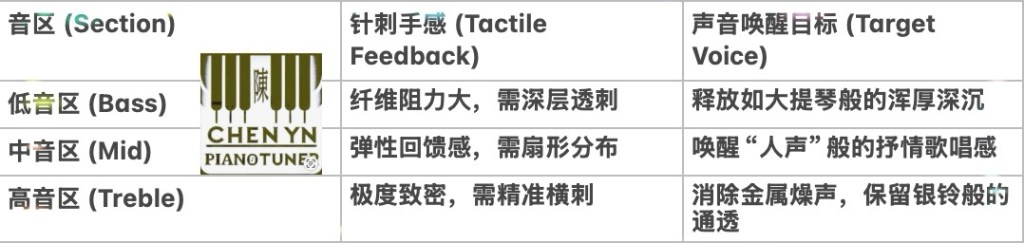
横向侧面针刺(Lateral Voicing)的微创艺术核心突破点:“表层不破,内压释放”,其技术细节具有三个深层物理逻辑。
1. 改变“非线性弹簧”的阻尼特性 (Damping Control),榔头击弦时,本质上是一个极其快速的压缩与反弹过程。如果榔头内部(核心区)太硬,它就像一块“死木头”撞击琴弦,触弦时间极短,能量释放过于突兀。通过从侧面刺入核心区,你实际上是在榔头内部创造了微小的“空气层”和“弹性间隙”。降低了榔头的动态硬度(Dynamic Stiffness)。当榔头击弦时,它不再是生硬的撞击,而是产生了一个“宽脉冲”。
2. 优化“驻波”的纯净度 (Standing Wave Optimization),干硬的榔头击弦时会激发出大量杂乱的、高频的不谐和泛音(Noise spikes)。这些高频能量会迅速消耗掉弦的振动能量,导致声音“散”得快。横向针刺的作用在于完全没有破坏击弦点(Crown)的表面张力,但软化了内部支撑。使榔头变成了一个完美的“滤波器”在击弦瞬间过滤掉了那些消耗能量的尖锐杂音,让振动能量集中在基音和协和泛音上。
3. 建立“能量缓冲仓”效应 (Energy Buffer Effect),传统的表面针刺容易让榔头表面变“虚”,导致击弦无力。横向针刺的作用从侧面刺入保留了表面的致密性(坚硬的壳),但在内部建立了一个柔韧的“缓冲仓”。这种操作实现了“强奏不炸,弱奏不虚”,在声音衰减的过程中,就像给钢琴安装了一个“音色避震器”,让声音不再是突兀地停止,而是像水波纹一样层层扩散。
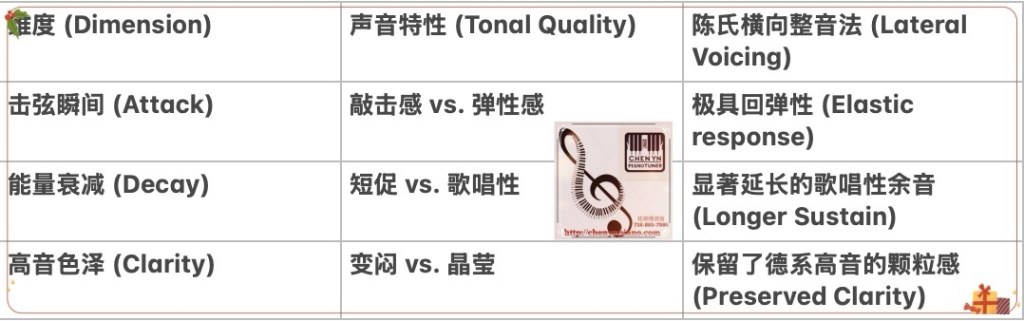
横向侧面针刺(Lateral Voicing)的真正魅力,在于它重塑了钢琴的‘衰减曲线’。 传统的表面针刺往往通过牺牲亮度来换取柔和,但音色往往变得单薄、衰减过快。而通过横向刺入榔头核心区,我们在不损伤击弦点能量传导的前提下,调整了榔头的内张力。这使得击弦瞬间的能量转换从‘碰撞’升华为‘耦合’,从而极大地延长了基音的余振时间。这就是为什么经过横向整音的 W. Hoffmann,能散发出一种如同顶级男高音般的‘歌唱性延音’。”
很多人担心整音会让钢琴失去亮度,但在 W. Hoffmann 的实战中,我采用了横向侧面针刺技法。这种技法的精妙之处在于:它在榔头内部构建了一个弹性缓冲层,释放了过度的内压,从而延长了触弦时间,让声音听起来更加温润(Soft)。但由于我完美避开了对击弦表层的破坏,这架琴原本高贵的德系明亮度(Brilliance)被完整地保留了下来。它不是变暗了,而是变深邃了。有三个关键词很重要:非线性弹性(Non-linear Elasticity):能量耦合(Energy Coupling):微创理念(Minimally Invasive):这种技法对 Wurzen 顶级毛毡结构的尊重“不伤表层,只动核心”。
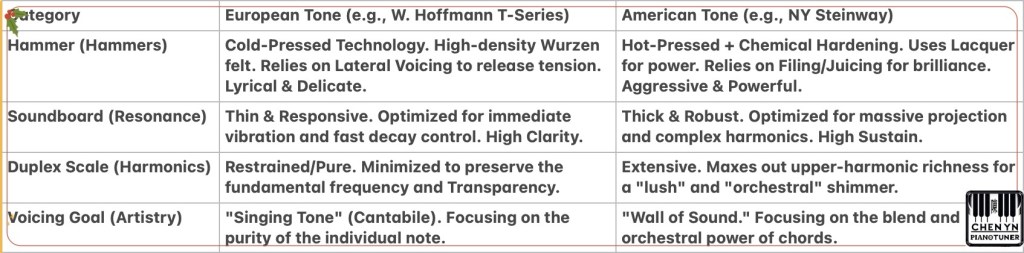
调准及整音一台 W. Hoffmann 并不难,难的是如何通过‘微创’整音,在不伤及击弦面(Crown)的前提下,释放冷压毛毡内部的压抑,换取那份迷人的歌唱性延音。看到客户满意的反馈,深感作为调音师,我们不仅是修理者,更是音色的雕琢者。2026春天绽开中医的“经络疏通”避开了皮肤(击弦点),直接作用于穴位(核心张力区)之花蕾将继续在针尖上重塑德系经典的尊严音色。感谢客户 Daniel Jeng 的极高评价——‘比以往任何调音师都高出好几个量级’。这不仅仅是对音准的认可,更是对通过横向侧面针刺(Lateral Voicing)唤醒德系纯净音色的肯定。

2026 年3月 美国—纽约
本文作者:陈益楠 (ChenYN Piano Tuner)纽约–波士顿钢琴调音技师
邮箱:ydy2301@gmail.com
电话:+1 718-885-7986
European Sound vs. American Sound: The Art of Lateral-Invasive Voicing
Having been a piano technician for nearly forty years, I find that the most enduring fascination remains the discernment of piano tone. Often, a piano’s voice hasn’t necessarily “deteriorated”; rather, awakening its crystalline purity requires the profound expertise and “backbone” of a craftsman—someone who truly understands its soul. Recently, a W. Hoffmann owner remarked that my work was “leagues above any other tuner” they had ever had. This feedback once again allowed me to appreciate the “mellow but not muffled, bright but not piercing” quality—a tone reminiscent of “pearls falling onto a jade plate.”
In recent years, through extensive experience with European pianos in the United States, I have delved into the fundamental clarity and transparent harmonic series of brands like W. Hoffmann. The emphasis on Purity and Clarity, particularly through Cold-Pressed technology, is the very soul that distinguishes these instruments from the “hot-pressed” industrial process. The raw tension and heritage of these handcrafted German instruments have revitalized my investigative spirit into the essence of the pure German tone.
Conversely, the American Sound, epitomized by Steinway & Sons, features extremely dense and broad harmonics. Its aesthetic core lies in explosive power and an orchestral, symphonic presence. Whether in tonal color or melodic lines, it possesses a rich, magnificent breadth and an oil-painting-like Thickness and Blend. In the English-speaking world, I greatly admire terms such as “Enhanced Tonal Bloom” and “Optimized Decay Profile”—qualities that many in China describe as a “Singing Sustain” akin to a world-class tenor.
As a craftsman who has tuned, voiced, and repaired over a thousand pianos, my deepest realization is that the distinction between European and American sounds must begin with the core data of the hammers. Moving from “noise” to “harmony,” the pivotal point is Transparency vs. Power, recognizing the hammer as the “vocal cords” of the piano. The W. Hoffmann T-Series inherits the original C. Bechstein German cold-pressing technology. The high-density fiber structure of the premium Wurzen felt preserves the natural oils and elasticity of the wool. Unlike the hot-pressing of common pianos, it does not rely on “force against force” but on a “supple yet resilient” quality. Compared to the “orchestral weight and roar” of a Steinway, a technician acting as a “tonal translator” discovers a sudden sense of enlightenment when faced with the quintessential European Transparency of a W. Hoffmann.
The Three Dimensions of Tonal Design: European vs. American Profiles
(Theory and Technical Support by Master Chen)
To visually articulate my tonal philosophy, I have developed three conceptual frameworks that illustrate the core differences:
Concept 1: Sustain Decay Envelope (Acoustic Comparison)
Using software to visualize two distinct amplitude curves:
- Standard Voicing (Dotted Line): Shows an extremely high peak at the moment of strike, characterized by a “harsh ping,” followed by a steep, rapid drop. The sustain is short and clipped.
- Lateral Voicing on W. Hoffmann (Solid Line): The peak is rounded and smooth. The decay process is exceptionally slow and stable, resulting in what I call an “Optimized Decay Profile.”
Concept 2: Stress Distribution Analysis (Hammer Cross-Section)
By analyzing the side profile of a hammer, we can color-code the stress zones:
- Red Zone (The Crown): Labeled “Preserved Tension,” this area ensures brilliance and clarity.
- Blue Zone (The Lateral Core): Labeled “Tension Released,” this creates an internal “buffer chamber.”
This specific technique achieves a tone that is “mellow but not muffled, bright but not piercing.”
Concept 3: Spectral Comparison (Harmonic Distribution)
Visualizing the frequency distribution of harmonic series:
- American Sound (e.g., Steinway): Features extremely dense and broad harmonics, emphasizing “Thickness” and “Blend.”
- European Sound (e.g., W. Hoffmann): Features clear fundamentals with an orderly, transparent harmonic series, emphasizing “Purity” and “Clarity.”
The “Minimally Invasive” Art of Lateral-Invasive Voicing
The core breakthrough of this technique is: “Preserving the Surface, Releasing the Core.” This process is governed by three deep physical logics:
1. Manipulating “Non-linear Spring” Damping (Damping Control)
A hammer striking a string is essentially a lightning-fast process of compression and rebound. If the internal core is too hard, the hammer acts like “dead wood,” resulting in an extremely short contact time and a jarring energy release. By needling laterally into the core, I create microscopic “air pockets” and “elastic gaps” within the felt. This reduces the Dynamic Stiffness of the hammer. Consequently, the strike is no longer a blunt impact but a “Wide Pulse” interaction.
2. Optimizing Standing Wave Purity (Standing Wave Optimization)
A hard, dry hammer creates a multitude of chaotic, high-frequency inharmonic overtones, or “Noise Spikes,” upon impact. This high-frequency energy rapidly dissipates the string’s vibrational energy, causing the sound to disperse and decay too quickly. The brilliance of Lateral Voicing lies in the fact that it preserves the surface tension of the Crown entirely, while softening the internal support. This transforms the hammer into a perfect “Acoustic Filter,” filtering out energy-draining noise spikes at the moment of strike. Consequently, the vibrational energy is concentrated into the fundamental frequency and its harmonic overtones.
3. Creating the “Energy Buffer” Effect (Energy Buffer Effect)
Traditional surface needling often makes the hammer’s surface too soft or “mushy,” resulting in a lack of power. Lateral Voicing, by contrast, enters from the side profile to retain the density of the surface (the “hard shell”) while establishing a resilient “Buffer Chamber” internally. This technique achieves a balance where “the forte is not jarring, and the piano is not hollow.” During the decay process, it acts as a “Tonal Shock Absorber,” ensuring the sound doesn’t cut off abruptly but ripples outward like waves on water.
Conclusion: The Transcendent Charm of Lateral-Invasive Voicing
The true allure of Lateral Voicing lies in its radical reshaping of the piano’s “Decay Curve.” Traditional surface voicing often sacrifices brilliance to achieve softness, but the resulting tone is frequently thin and decays prematurely. By needling laterally into the hammer’s core, we recalibrate the internal tension without compromising the energy transmission of the strike point.
This elevates the energy conversion at the moment of impact from a mere “Collision” to a profound “Coupling,” significantly prolonging the resonance of the fundamental frequency. This is precisely why a W. Hoffmann, after undergoing Lateral Voicing, exudes a “Singing Sustain”—reminiscent of the lyrical power of a world-class tenor.
Preserving Brilliance through Precision: The Paradox of Softness
Many fear that voicing will cause a piano to lose its brilliance. However, in my recent work with the W. Hoffmann, I employed the Lateral-Invasive Voicing technique. The genius of this method lies in its ability to construct an internal elastic buffer layer within the hammer. By releasing excessive internal pressure, we extend the contact time, resulting in a tone that is perceptibly “mellow” and “soft.” Yet, because I meticulously avoided any damage to the strike surface (the crown), the noble German Brilliance of this instrument remains perfectly intact. The sound has not become “dull”; it has become “profound.”
Three key technical pillars define this approach:
- Non-linear Elasticity: Creating a “smart” spring effect within the felt.
- Energy Coupling: Optimizing the energy transfer from hammer to string.
- Minimally Invasive Philosophy: A profound respect for the premium Wurzen felt structure—preserving the surface while only manipulating the core.
The Tonal Sculptor: Beyond Repair
Tuning or voicing a W. Hoffmann is not inherently difficult; the true challenge lies in performing “minimally invasive” voicing. The goal is to release the repressed tension within the cold-pressed felt without harming the Crown, thereby exchanging that tension for a captivating, lyrical sustain.
Reflecting on my client’s satisfied feedback, I am deeply reminded that as piano technicians, we are not merely repairers—we are sculptors of sound. In this spring of 2026, my technique has bloomed like the traditional Chinese practice of “meridian clearing” (acupuncture)—bypassing the “skin” (the strike point) to act directly upon the “acupoints” (the core tension zones).
I will continue to utilize the tip of my needle to reshape and uphold the dignity of the German classics. I am immensely grateful for the high praise from my client, Daniel Jeng, who described my work as being “leagues above any other tuner” he has ever had. This is not just a recognition of pitch accuracy; it is an affirmation of the art of Lateral Voicing and its power to awaken the crystalline purity of the German tone.
 New York Piano Tuner : I used ear tuning (also known as auditory tuning) and state-of-the-art software-based electronic tuning equipment for sound tuning. (The frequency for home concert tuning is 442 Hz.) 我采用耳调音法(也称听觉调音法)和最先进的基于软件的电子调音设备进行调音。(家用音乐会调音的频率为 442 Hz) Chen YN 调音主页
Leave a comment