
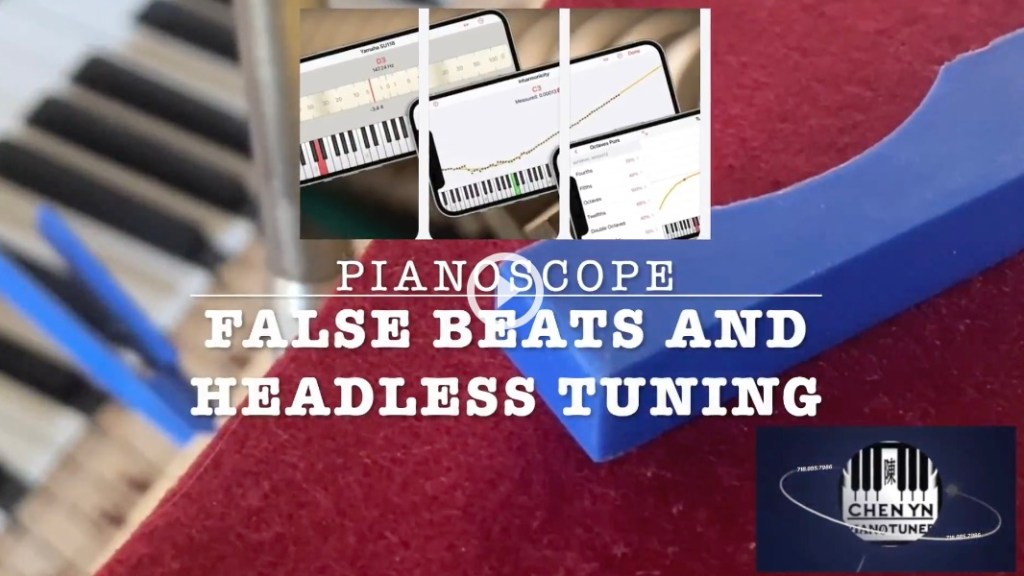
Pianoscope:具备极高的计算精度,在处理不规则振动时表现优异。无头调音”(Headless Tuning)模式的优势在于可以专注听觉调音模式,调音师可以更多地依靠耳朵进行艺术化微调。此次遇到具有假拍(False Beats)的弦也是由于老琴弦列的遗留问题所致,检查排除硬件的物理病灶可采用软件的“无头调音”Headless Tuning模式处理假拍环节效果颇佳。
早年学习调律技术其中威廉•布雷德•怀特对假拍(False Beats)的研究记忆犹新,他认为这是调音师最为棘手的拦路虎。当今软件时代依然非常容易被假拍误导,为此多年来的使用各款软件的心得体会颇多。其中频谱显示(Spectrum Display)辅助定位、相位锁定(Phase Display)抗干扰、同度调音(Unison Tuning)纯净度等,都显示软件辅助下的处理策略。
如下简述具体利用软件采取的几种专业手段:
1、寻找“最稳点”:软件能比人耳更敏感地捕捉到能量最强的频率点。当假拍不可避免时,调律师通常通过软件观察频谱,将音高锁定在两个微小波峰的能量中心点,这样在听感上能将干扰降到最低。
2、利用高次泛音对准:假拍往往在基频(1st Partial)表现明显。你可以尝试将软件的监测点切换到第4或第6泛音(高频部分)。如果高次泛音的频谱较稳,以高次泛音为基准定弦,往往能获得更纯净的同度效果。
3、同度遮盖法 (Masking):如果同组的三根弦中有一根有严重假拍,软件可以帮你先把另外两根绝对调准。然后通过人耳微调那根带假拍的弦,使其假拍的周期与整体音色融合,避免产生令人烦躁的“狼音”。
4、物理干预(配合软件验证):按压马钉(Seating the bridge)、调整挂弦钉(Hitching)、更换敲击点……。切记以上处理环节务必保持环境绝对安静及相应软件的熟悉程度。
近年在美国和多位顶级调音大师的接触中,学习及接触软件 pianoscope ,其中“无头调音”(Headless Tuning)是 Pro 版提供的一项特殊功能,其核心逻辑是简化视觉干扰。 假拍 (False Beats) 的识别与调整需要调音师更多地依靠耳朵进行微调,pianoscope 通过以下功能帮助识别和规避假拍的干扰:泛音频谱视图 (Partial Spectrum)、多麦克风协同 (Multi-Channel Audio)、延长冻结时间 (Extended Freeze Times),具体策略为切换泛音参考、物理定位与消除、同度相消法等。 在 pianoscope 使用 中,“耳听为主、软件为辅”的艺术化调音状态, “Strobe(频闪)”模式 和 “Inharmonicity(不谐和性)”这种“人机合一”的状态堪称顶级大师调音模式。
我的恩师金先彬先生曾经多次寄语释义,就四.五度必须用三.六度检验法去校正才能达到较高精度。四五度检验法 (P4-P5 Test)、八度检验 (Octave Tests)、三六度检验法 (M3-M6 Test / Major Thirds – Major Sixths Test)、这些都是平均律(Temperament)最常用的方法,在钢琴精调音的艺术化微调中,“检验音程”(Test Intervals)是判断软件计算出的拉伸曲线是否符合听感的核心工具。当然在进行艺术化微调时,可能会用到这些动词:Expand the Interval:把音程调宽、Contract the Interval:把音程调窄、Smooth out the beats:通过微调让拍音过渡得更平滑(特别是在处理带假拍的弦时),当“果断信任耳朵”时,Beatless:无拍的(绝对纯净)、Dead / Dull:形容音色发闷、没有张力、Resonant / Singing:形容调准后钢琴产生的共鸣和“歌唱感”以及Interval Weights:音程权重、Partial Matching:泛音匹配等偏好。其中我认为三六度检验 (M3-M6 Check)依然是必杀技之一。
pianoscope 艺术化调音模式的核心境界 (The Golden Rule)在于无头模式 (Headless Mode)
2026 年于纽约–波士顿
Professional Reflections on Piano Tuning: Pianoscope and the Art of Managing False Beats
Pianoscope offers exceptional computational precision and performs remarkably well when dealing with irregular string vibrations. The advantage of “Headless Tuning” mode lies in its ability to facilitate a purely aural tuning environment, allowing technicians to rely more on their ears for artistic micro-adjustments. When encountering False Beats caused by legacy issues in aging string scales, the “Headless Tuning” mode is particularly effective for isolating and managing these “physical lesions” once hardware issues have been ruled out.
Reflecting on my early studies of tuning technology, William Braid White’s research on False Beats remains vivid in my memory; he considered them the most formidable obstacle for a tuner. Even in today’s software-driven era, it is easy to be misled by false beats. Over years of using various software, I have developed several strategies: using Spectrum Display for assisted positioning, Phase Display for interference rejection, and monitoring Unison Tuning purity.
Specific Professional Strategies Using Software:
- Finding the “Stable Point”: Software is more sensitive than the human ear at capturing the peak energy frequency. When a false beat is unavoidable, I observe the spectrum and lock the pitch at the energy center between two micro-peaks to minimize perceived interference.
- Utilizing Higher Partials: False beats are often most prominent at the 1st Partial (fundamental). By switching the software’s monitoring point to the 4th or 6th partial, one can often find a more stable reference to achieve a cleaner unison.
- The Masking Method: If one string in a trichord has a severe false beat, use the software to perfectly tune the other two first. Then, fine-tune the problematic string by ear so its beat cycle blends into the overall tone, avoiding “wolf tones.”
- Physical Intervention with Software Verification: Techniques such as Seating the bridge, adjusting Hitching, or changing the Strike Point should be verified with software in an absolutely quiet environment.
During my recent interactions with top master tuners in the US, I have further explored Pianoscope Pro. Its “Headless Tuning” core logic is to eliminate visual distraction. Since identifying and adjusting False Beats requires the tuner’s ear for micro-nuances, the software assists via Partial Spectrum views, Multi-Channel Audio (multi-mic synergy), and Extended Freeze Times. The ultimate “human-machine synthesis” is achieved in Strobe and Inharmonicity modes—the hallmark of a master.
My mentor, Mr. Jin Xianbin, often taught that P4/P5 intervals must be calibrated using M3/M6 tests to reach high precision. These Test Intervals (P4-P5, Octave, and M3-M6 checks) are the core tools used to judge whether a software-calculated stretch curve actually satisfies the ear. In this state of artistic refinement, we use a specific vocabulary: Expand or Contract the interval, Smooth out the beats, or strive for a Beatless, Resonant, and Singing tone rather than a Dead or Dull one. Adjusting Interval Weights and Partial Matching preferences is key, but the M3-M6 Check remains the “ultimate weapon.”
The highest realm of artistic tuning in Pianoscope is the Headless Mode (The Golden Rule).
New York – Boston, 2026
 New York Piano Tuner : I used ear tuning (also known as auditory tuning) and state-of-the-art software-based electronic tuning equipment for sound tuning. (The frequency for home concert tuning is 442 Hz.) 我采用耳调音法(也称听觉调音法)和最先进的基于软件的电子调音设备进行调音。(家用音乐会调音的频率为 442 Hz) Chen YN 调音主页
Leave a comment